Gyeonghuigung Palace: The Palace Seoul Nearly Lost
In 1616, when King Gwanghaegun decided to build a new palace west of Gyeongbokgung, his architects chose a site with a complicated history. A powerful royal clan owned the land — the family of Prince Jeonwon-gun, whose grandson would eventually overthrow Gwanghaegun himself.
But the palace rose anyway. Construction took years. The result was a complex of over 100 buildings spread across the hillside terrain of what is now central Seoul. The Joseon court called it "Seogwol" — the Western Palace — to distinguish it from "Donggwol" (the Eastern Palace), meaning Changdeokgung.
For over two centuries, Gyeonghuigung functioned as an important secondary palace where kings lived, held court, and occasionally made history. King Yeongjo — arguably Joseon's most consequential monarch — was born within these walls in 1694 and died here in 1776, a reign of 52 years that transformed the dynasty.
Today, most visitors to Seoul have never heard of it.
The Western Palace at Its Height
To understand how significant Gyeonghuigung once was, you need to grasp the Joseon palace system. Gyeongbokgung, built in 1395, was the ceremonial center — imposing, formal, built to project royal power. When it burned during the Japanese invasions of 1592-1598 and wasn't immediately rebuilt, the Joseon court needed alternatives.
Changdeokgung and Changgyeonggung became the Eastern Palace complex, handling politics and residential life for over a century. Gyeonghuigung emerged as the Western Palace: a fully equipped secondary court.
At its height, the palace stretched across an area roughly equal to today's Gyeonghuigung and the neighboring Seoul History Museum grounds combined. The main throne hall, Sungjeongjeon, received kings and officials. Auxiliary halls housed royal family members. Gardens and ponds offered retreat.
What set Gyeonghuigung apart was its relationship to the landscape. Unlike Gyeongbokgung's flat, geometrically precise plan, Gyeonghuigung followed the natural contours of the Inwangsan foothills. Buildings stepped up the hillside. Paths curved around pine trees that had stood longer than the palace itself. It was a more organic, less formal space — which perhaps explains why the kings who used it most, like Yeongjo, seemed to find it congenial.
King Yeongjo reigned from 1724 to 1776. The palace saw his greatest triumphs and his most agonizing decisions, including the tragic execution of his son Crown Prince Sado — an event so painful that Joseon historians could barely bring themselves to write about it directly.
How Japan Erased a Palace
This is the part of Gyeonghuigung's story that most tourists don't know, and it's the one that matters most for understanding what you see today.
After Japan annexed Korea in 1910, colonial administrators faced a practical problem: what to do with the remaining Joseon palaces? Their approach to Gyeonghuigung was systematic dismantlement.
Beginning in 1910, buildings were auctioned off, relocated, or demolished. The scale of the loss was staggering. Over the following decades, what had been a complex of more than 100 structures was reduced to bare ground.
The main gate, Heunghwamun, suffered a particularly pointed humiliation. It was moved and repurposed as the front gate for a shrine dedicated to Ito Hirobumi — the Japanese Resident-General who had forced the protectorate treaty on Korea in 1905. The throne hall, Sungjeongjeon, was dismantled and transported to Dongguk University's campus, where it was reassembled and used as a lecture hall for the university's Buddhist studies department.
By 1932, a Japanese middle school occupied the palace grounds. That school eventually became today's Seoul High School, which remained on the site until the 1980s.
The Japanese authorities likely understood the symbolism of what they were doing. Transforming a royal palace into a school, using the royal gate to honor the architect of Korean subjugation — these weren't accidents. They were choices.
What Survived, and What Came Back
When Korea's cultural preservation movement gained momentum in the 1980s, Gyeonghuigung was near the top of the list.
The Seoul city government developed a restoration plan. Seoul High School relocated. Excavations began to map the original palace footprint. Buildings were reconstructed based on historical records, old maps, and surviving documentation.
Heunghwamun, the main gate, was returned to the palace site in 1988. Finding an original Joseon palace gate that had survived colonial rule — even in a displaced, repurposed condition — and returning it home was a meaningful act. The gate stands today at the west entrance, looking exactly as it did in old photographs: heavy timber, double-leaf doors, a layered tile roof with the gentle upward curve of Joseon architecture.
Sungjeongjeon is more complicated. The original hall remains at Dongguk University. A reconstruction was completed on the Gyeonghuigung site in 1994, using traditional building methods and materials. It's not the original building, but it represents what the original looked like — the same proportions, the same structural logic, the same relationship to the courtyard in front of it.
Taeryeongjeon, a smaller hall where a portrait of King Yeongjo is kept, is open to visitors. It's a quieter, more intimate space than the throne hall, and the portrait — a reproduction of the original, which is held in a museum — gives the room a particular kind of presence.
The grounds as you find them today are partially reconstructed, partially maintained as open green space, and partially still under study. That incompleteness is itself significant. You're visiting a palace that's still in the process of being remembered.

Walking Through Gyeonghuigung
The palace entrance from the main road puts you immediately before Heunghwamun. Take a moment here. This gate is original — one of the few pieces of the palace that survived the colonial era in material form, even if it traveled a long road to get back.
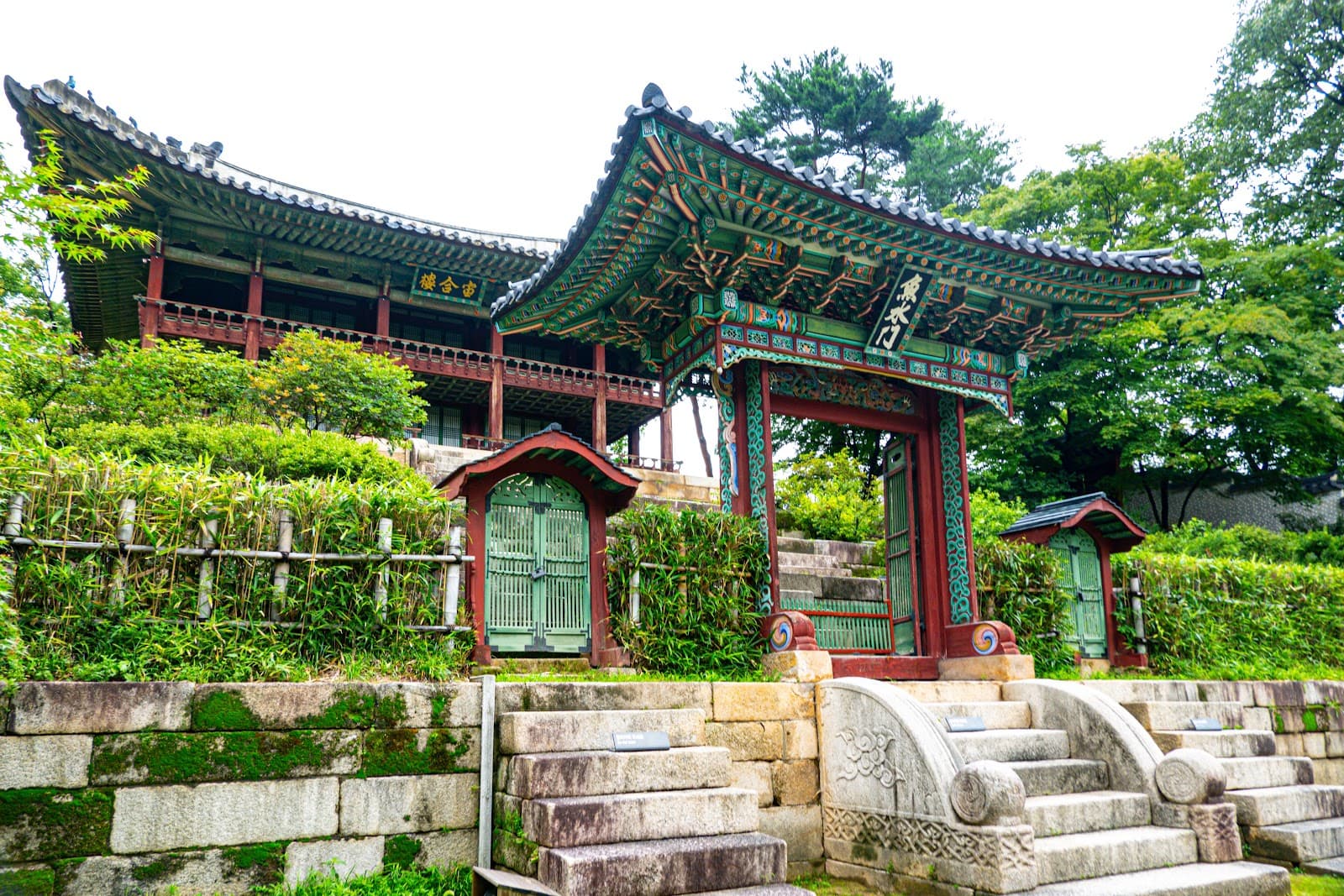
Through the gate, the path leads up to Sungjeongjeon across a stone-paved courtyard. The throne hall faces south across an open space where rank stones once marked the positions of civil and military officials during royal audiences. The reconstruction is careful. The building's proportions feel right — not too large, not too intimate. The dancheong (colorful decorative patterns on woodwork) has been freshly applied and will age with time.
North of Sungjeongjeon, the path climbs into what becomes almost a woodland walk. Pine trees shade the route. Stone foundations mark where buildings once stood. At the upper level, you find Taeryeongjeon and several reconstructed secondary halls.
The whole compound is quiet — genuinely quiet, not just "quieter than Gyeongbokgung." Most days you'll have long stretches of the palace to yourself. That's unusual for central Seoul.
Allow 45-60 minutes for the palace itself. Then cross the small road to the Seoul History Museum.
Seoul History Museum: The Essential Companion Visit
Gyeonghuigung makes much more sense after visiting the Seoul History Museum, which is free and sits on the adjacent grounds. Or visit the museum first — either order works.
The museum's permanent collection traces Seoul's history from the prehistoric settlements along the Han River through the Joseon Dynasty, the colonial period, the Korean War, and the rapid modernization of the 20th century. For visitors from outside Korea, this context is invaluable.
The colonial-period galleries are particularly relevant to Gyeonghuigung. Photographs from the early 1900s show the palace in its dismantled state. Maps document the school that replaced it. The museum doesn't shy away from this history — it presents it directly.
There are also rotating temporary exhibitions, which change every few months. Check the museum's website before visiting to see what's on.
One practical note: the museum has excellent cafes and restrooms. Plan your Gyeonghuigung visit around the museum facilities, since amenities inside the palace itself are minimal.
Visitor Information 2026
Hours
- Palace grounds: 09:00–18:00 (last entry 17:30)
- Closed Mondays
- Open year-round including national holidays
Admission
- Gyeonghuigung Palace: Free
- Seoul History Museum permanent collection: Free
- Special exhibitions at Seoul History Museum: Varies (usually ₩2,000–5,000)
Getting There
Gyeonghuigung is in Sinmunno, Jongno-gu — easily walkable from several subway stations:
- Line 5, Seodaemun Station (Exit 4 or 5): 5-minute walk, closest stop
- Lines 5/2, Chungjeongno Station: 10-minute walk heading east
- Gwanghwamun Station (Line 5, Exit 7): 15-minute walk west along Sejong-daero
The palace is across the street from the Seoul Metropolitan Government building. If you're coming from Gyeongbokgung or Gwanghwamun, it's a 15-minute walk west.
Address: 55 Saemunan-ro, Jongno-gu, Seoul
Photography
Personal photography is freely permitted throughout the palace grounds. The lighting is best in the morning, when sunlight catches the dancheong on Sungjeongjeon from the east.
Time Required
- Palace only: 45-60 minutes
- Palace + Seoul History Museum: 2-2.5 hours
- Palace + Museum + walking to Deoksugung: Add another 30-45 minutes
Combining With Nearby Sites
Gyeonghuigung sits at an interesting crossroads of Seoul's heritage district. Within walking distance:
Deoksugung Palace is about 15 minutes on foot heading southeast. Together, Gyeonghuigung and Deoksugung offer a study in contrasts: the partially reconstructed palace of the classical Joseon era and the late-Joseon palace that became the center of Korea's modernization crisis.
Gwanghwamun Square is 15 minutes east — the plaza in front of Gyeongbokgung Palace, with the statues of King Sejong and Admiral Yi Sun-sin. From Gwanghwamun, you can access Gyeongbokgung and the National Palace Museum of Korea.
Jeongdong district, with its 19th-century foreign legation buildings and churches, is a 10-minute walk southeast. This area saw the foreign powers of the late Joseon era establish their embassies — it's an important chapter in the context of the colonial period you'll have just been thinking about at Gyeonghuigung.
What Gyeonghuigung Teaches
There's a particular feeling to walking through Gyeonghuigung that you don't quite get at Gyeongbokgung or Changdeokgung. Those palaces, fully restored or very nearly so, give you a sense of Joseon's grandeur. Gyeonghuigung gives you something different: a sense of what it means to lose something and try to get it back.
The reconstruction is honest about itself. The new buildings are clearly new — the wood is too clean, the colors too bright, the stone too unweathered. They'll look different in fifty years. But the stone foundations are original. The landscape — the pine trees, the hillside contours, the way the path rises — is original. Heunghwamun is original.
It's important to understand that the palace you see isn't a recreation of what once existed. It's an ongoing effort to remember. That difference matters. At Gyeonghuigung, you're not visiting a finished museum piece. You're participating in a recovery.
King Yeongjo, who spent much of his long life within these walls, would have known every corner of the palace. The throne hall where he held audiences. The garden paths where he walked in the early morning. The small hall where his portrait now hangs.
Reconstruction can't fully bring back what was lost. But it can insist on remembering. That's what Gyeonghuigung does.
Frequently Asked Questions
Is there an admission fee for Gyeonghuigung? No. Gyeonghuigung Palace is free to enter. The adjacent Seoul History Museum permanent collection is also free. Special temporary exhibitions at the museum may charge a small fee (typically ₩2,000-5,000).
Is Gyeonghuigung one of the Five Grand Palaces? Yes — Gyeonghuigung is officially one of the Five Grand Palaces (오궁) of the Joseon Dynasty, alongside Gyeongbokgung, Changdeokgung, Changgyeonggung, and Deoksugung. Most tourists visit the first two or three and overlook the remaining two.
How does Gyeonghuigung compare to the other palaces? It's smaller and less complete than Gyeongbokgung or Changdeokgung. But its story — systematic colonial erasure followed by painstaking recovery — makes it one of the most historically significant sites in Seoul for understanding Korean cultural heritage and its relationship to the colonial period.
Is the palace crowded? No. Gyeonghuigung is one of the least-visited of Seoul's five palaces. On most weekdays, you'll have large sections of the grounds largely to yourself. Even on weekends, crowds here are nothing like Gyeongbokgung.
Is the Seoul History Museum worth visiting? Yes, strongly. The museum provides context that makes Gyeonghuigung much richer. The collections on the colonial period and modern Seoul are particularly well-presented, and the permanent collection is free.
When is the best time to visit? Spring (April-May) and autumn (October-November) are most pleasant. The palace grounds have mature pine trees and open stone courtyards, so the foliage colors are subtle but beautiful in both seasons. The palace is also worth visiting in early morning in any season, when the light on Sungjeongjeon is best and the grounds are quietest.
Is Gyeonghuigung accessible? The main palace courtyard and Sungjeongjeon area are wheelchair accessible. Some paths to the upper parts of the grounds involve stone steps. The Seoul History Museum is fully accessible.
Why did Japan dismantle Gyeonghuigung? Colonial Japan demolished most of the palace grounds to establish a Japanese school (Keijo Middle School) and to remove visible symbols of Korean royal authority. Key structures — including the main gate and throne hall — were relocated and repurposed in ways that were symbolically pointed. This was part of a broader colonial policy of cultural suppression.