
Bukchon in Spring 2026: Cherry Blossoms, Silent Alleyways, and the Village That Survived
I came to Bukchon the first time in November. The tiled roofs were wet from overnight rain. The alleys were narrow and steep and cold. A few tourists photographed the famous viewpoint at Bukchon-ro 11-gil, phones raised toward the row of rooftops descending toward Gyeongbokgung. A security guard stood at the corner, watching.
Busy, I thought. Famous. A little exhausted-looking.
Then I came back in April.
The same narrow alley had cherry blossoms arching over the rooftops — pale pink against the dark grey of traditional tiles. The morning light came in low and soft. Because I'd arrived before seven, I was almost alone. One other person, camera in hand, stood silently at the viewpoint looking down the slope. We didn't need to speak. The scene made its own point.
That's what spring does to Bukchon. It removes everything that makes the place feel overworked and gives you back something that feels like it belongs to a different era.
How Bukchon Got Its Visiting Hours
Before I describe what spring looks like here, I want to explain something that shaped how I experience the neighborhood now.
In 2023 and early 2024, Bukchon's resident population had begun to genuinely suffer. The village is not a museum. Around 900 families still live in the 2,000-plus hanok that cover the hillside between Gyeongbokgung and Changdeokgung Palaces. During peak tourist season, Bukchon-ro 11-gil — the viewpoint alley — saw thousands of visitors per day, many of them arriving before dawn. Residents couldn't sleep. Couldn't leave their homes without being photographed. Couldn't have normal lives.
In 2025, the city of Seoul and Jongno-gu district implemented mandatory quiet hours: Bukchon's most sensitive residential areas are restricted to visitors only between 10am and 5pm on weekdays, and 10am to 6pm on weekends. Outside these hours, the alleyways around the viewpoint are reserved for residents.
The effect has been significant. Peak hours are still busy. But early morning — especially on weekdays — Bukchon has returned to something approaching its former self.
For spring 2026 visitors: arrive before 9am on weekdays. The alleys are quiet. The cherry blossoms are undisturbed. The light is better for photography. And you're seeing a neighborhood that's trying, imperfectly and with real effort, to remain a place where people actually live.
The Village Between Two Palaces
The name Bukchon (北村, "Northern Village") tells you where it sits: north of Cheonggyecheon Stream, between Gyeongbokgung to the west and Changdeokgung to the east. During the Joseon Dynasty, this position was significant. Yangban aristocrats and government officials — the people closest to the king — lived in Bukchon. The alley layout, the walled compounds, the sight lines toward the palace gates: all of it was status expressed in urban geography.
The village survived the Japanese colonial period intact, though the large aristocratic estates were subdivided in the 1930s to create smaller, more affordable urban hanok — the style you still see today. It survived the Korean War largely unscathed. It survived the rapid modernization of the 1960s and 70s because the hillside terrain made redevelopment difficult. And it survived the tourist wave of the 2010s, though barely.
The spring you experience here is flowering inside something that has endured an enormous amount. That context is worth carrying with you as you walk.
What Happens in Spring
Bukchon's cherry blossoms are not the dramatic mass blooms of Seokchon Lake or Yeouido's riverside. There's no continuous pink canopy, no reflecting lake, no festival booths selling flower-shaped desserts.
What happens instead is quieter and, depending on your temperament, more affecting: individual cherry trees planted along the alleyway walls bloom above the horizontal lines of tiled roofing. Pale petals drift onto stone paths. The grey-brown palette of the neighbourhood — winter hanok are monochromatic in a way that's almost abstract — warms and softens.
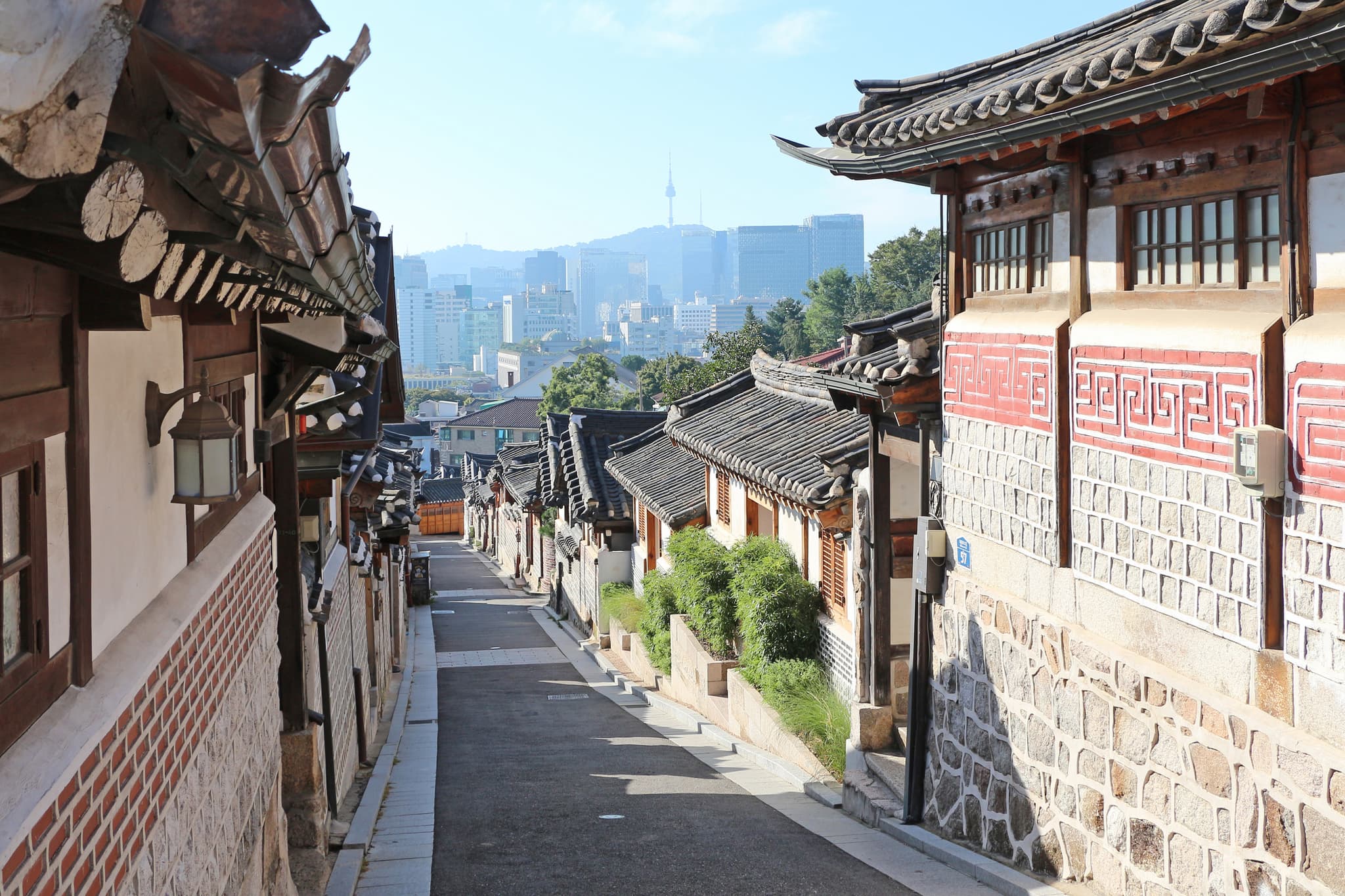
The most photogenic spot, predictably, is Bukchon-ro 11-gil, where the downhill view takes in a staircase of rooftops with the distant tower blocks of central Seoul behind them. In spring, the frame fills with blossom. If you come when it's quiet, the view is extraordinarily still.
Bloom timing for 2026: Cherry blossoms in Bukchon typically follow central Seoul by a day or two, as the hillside traps cold air slightly longer. Expect peak bloom around April 4–7, a few days after Seokchon Lake's peak of April 3–5.
The Spring Walk
Bukchon is navigable without a map if you follow the slope logic: uphill toward the ridge, then wander laterally, then down through whichever alley presents itself.
Start at Anguk Station, Exit 3 (Line 3). The walk uphill through Bukchon-gil takes about eight minutes to reach the first row of properly dense hanok. Don't rush this approach. The transition from the commercial street at the bottom — coffee shops, small galleries — into the residential alley is gradual, and the shift in atmosphere is worth tracking.
Bukchon-ro 11-gil viewpoint: This is the famous descent. Stand at the top and look south. In spring, the rooftops you see below are bracketed by blossoms. Go slowly. The stone steps are steep and irregular. Early morning, you might have this entirely to yourself.
The eastern alleyways: Most visitors come only for the 11-gil viewpoint. The alleys on the eastern slope — accessible by continuing along Bukchon-ro from the viewpoint — are quieter, less photographed, and in some ways more honest. The hanok here are less picture-perfect. There are signs of ordinary life: bicycles leaning against walls, small kitchen gardens, laundry hung above stone paths.
The northern ridge: At the top of the hill, the view opens briefly toward Bugaksan Mountain, the wooded ridge that forms Seoul's northern boundary. On a clear spring morning, snow sometimes lingers on the upper slopes while the valley below is already in bloom. Worth a pause.
After the Walk: Three Cafes
Bukchon's cafe scene operates in a specific register — not Seongsu-dong's industrial cool, not Hongdae's density, but something that tends toward craft materials, good natural light, and hanok-adjacent architecture.
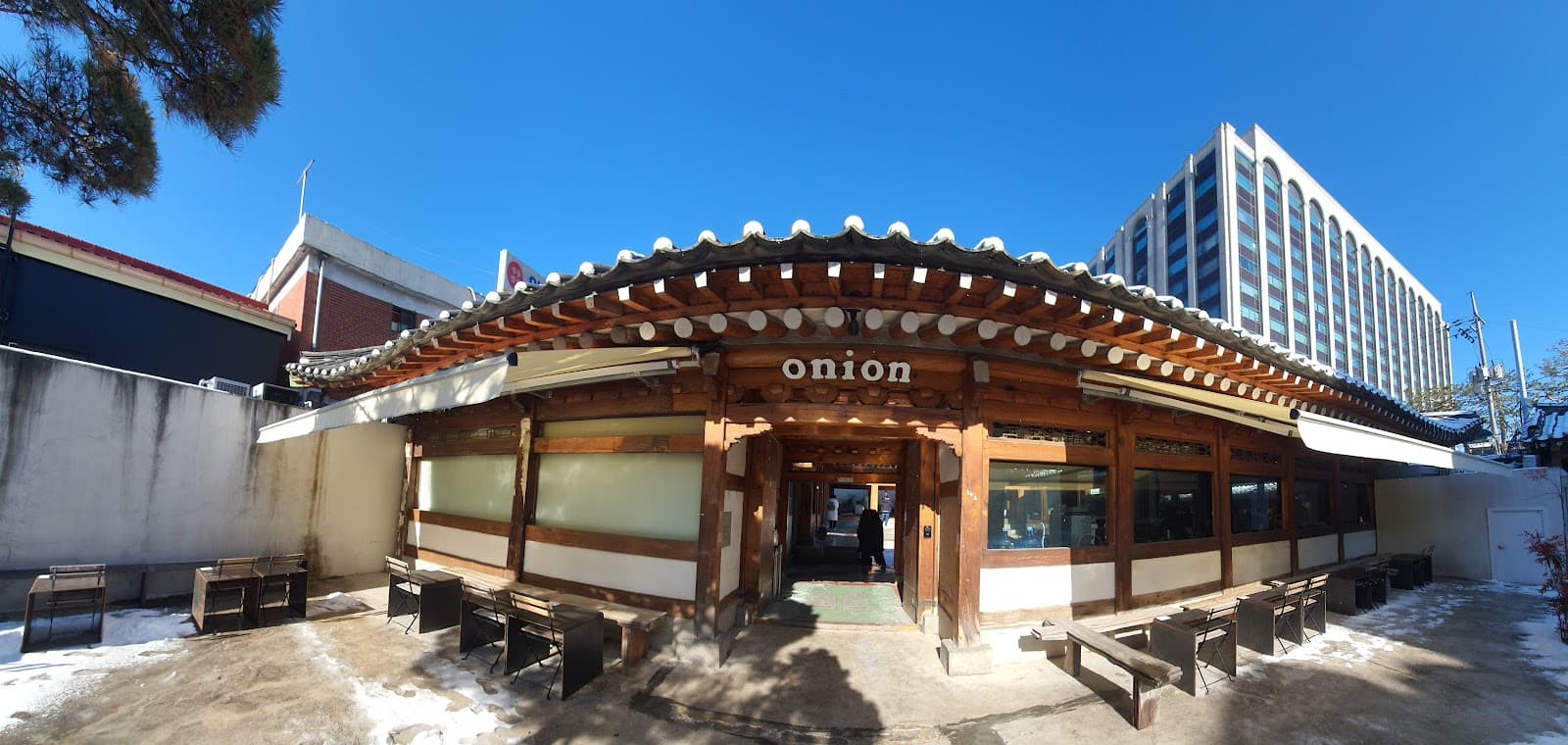
Chatteul Bukchon: A few minutes' walk east of Bukchon-ro, this small cafe occupies a converted hanok. The windows look out over a narrow garden; the seating is limited. Coffee is careful, not showy. Arrive before 11am if you want the morning atmosphere rather than the queue.
Green Mile Bukchon: On the commercial street leading up from Anguk Station. Long opening hours, good light, a well-edited menu. Their drip coffee is reliable and the seating near the window is worth claiming if available. Good for a post-walk reset before Samcheong-dong.
Low Roof Bukchon: On the quieter alleyways behind the main visitor path. The name describes the ceiling: it's the kind of low, domestic space that makes sense in hanok architecture. On a cold spring morning, it feels genuinely warm in the non-metaphorical sense. They usually have a small seasonal drink on the menu — in spring, something involving yuzu or plum.
Connecting to Samcheong-dong
Bukchon transitions naturally into Samcheong-dong to the west — the gallery and restaurant street that runs parallel to the eastern edge of Gyeongbokgung Palace. The two neighborhoods are connected by the middle ridge of Bukchon-ro.
In spring, this ten-minute walk between them passes through one of the most visually coherent urban sequences in Seoul: tiled hanok rooftops, early cherry blossoms, the pine forest of Bugaksan visible through gaps in the walls, and eventually the stone lanterns and ginkgo trees at the entrance to the Gyeongbokgung precinct.
Most visitors pick one or the other. Walking both, as a continuous spring morning route, is one of the pleasures of Seoul in April.
Practical Information
Visiting Hours (2025–2026 regulations)
- Bukchon-ro 11-gil viewpoint and adjacent residential alleys: 10am–5pm weekdays, 10am–6pm weekends
- Best window for uncrowded spring photography: before 9am on weekdays
- The visiting hours restriction covers the most sensitive residential zone; the commercial streets and lower alleyways remain open outside these hours
Getting There
- Line 3, Anguk Station, Exit 3: 8-minute walk uphill to Bukchon-ro
- Or: Line 3, Gyeongbokgung Station, Exit 2 and walk east along Hyoja-ro — longer (15 min) but passes the front gate of the palace
Best Visit Times for Spring 2026
- Weekday mornings, before 9am: quietest, best light, cherry blossoms undisturbed
- Weekday afternoons 1–3pm: visitor hours in effect, moderate crowd, good light for photography
- Avoid weekends between 11am–3pm during peak bloom (April 4–7): this is when the neighborhood is most congested
Spring Bloom Calendar
- First blossoms: late March/early April (street-level cherry trees open first)
- Peak bloom: approximately April 4–7, 2026
- Petal fall: April 10–13
Connecting Content
- Cherry blossoms at Seoul's palace precincts: Cherry Blossoms at Seoul's Historic Sites 2026
- Samcheong-dong guide: Samcheong-dong Guide 2025
- Hanok architecture in depth: Seoul Hanok Village Guide 2025
- Crowd-free blossom alternatives: Hidden Cherry Blossom Spots in Seoul 2026
Bukchon in spring is one of those combinations that should be obvious but somehow catches you off guard every time. Tiled roofs are not usually associated with cherry blossoms. Grey and pink shouldn't work together as well as they do. But they do.
Come early. The city is still quiet. The blossoms are still opening. The alleys belong, briefly, to the morning — to residents walking dogs, to the light coming through at the angle it only ever hits on that one specific day, to you, if you've made the effort to arrive before the day begins.
The village has survived a great deal to get here. It deserves a few quiet hours with the blossoms before the rest of Seoul shows up.