
Changsin-dong: Walking Seoul's Hidden Sewing Village Above Dongdaemun
I first found Changsin-dong by accident.
I'd spent the morning at DDP — Dongdaemun Design Plaza, Zaha Hadid's futuristic mass of aluminum and steel that anchors the fashion district below. By noon I was done with design and ready to walk, so I headed north on a whim, following a narrow road that curved uphill away from the boutique towers and wholesale textile floors.
The street tilted sharply. Then again. Within five minutes I was climbing stone steps between buildings that looked like they hadn't changed since the 1970s: low-rise apartments with rusted water tanks, tiny corner shops, laundry hung from every second window. And then I heard it — a sound I couldn't immediately place. A mechanical staccato, rhythmic but not musical, coming from behind a window with the curtains half-drawn.
Sewing machines.
Not one. Not a dozen. I stopped and listened. The sound was coming from every direction — from the building on my left, from the floor above, from a half-open metal door down the alley. Somewhere up here, in the ordinary-looking apartment blocks on the slope of Naksan hill, hundreds of people were making clothes.
I had stumbled into Changsin-dong: one of the few neighborhoods in Seoul where the past didn't vanish. It just kept going.
A Neighborhood Built on Thread
To understand Changsin-dong, you need to understand Dongdaemun.
Since the 1970s, the streets around Dongdaemun — the Great East Gate, one of Seoul's original cardinal gates — became the center of Korea's wholesale textile and fashion industry. Gwangjang Market to the west. Doota and Migliore malls near the gate itself. Hundreds of fabric wholesalers, button shops, zipper stalls, pattern makers. If you were making clothes in Korea, you bought your materials here.
But someone had to sew them.
That's where Changsin-dong came in. The neighborhood rises directly north of the fashion district, climbing the slopes of Naksan (낙산, Camel Mountain, 125 meters). Through the 1970s, 80s, and 90s, thousands of garment workers — called sidasaeng, subcontracted sewers — set up small workshops in the neighborhood's apartment buildings. They took bulk material orders from the market below, cut and assembled them overnight, and delivered finished pieces down the hill by morning.
At its peak, Changsin-dong had over 15,000 garment workers. Today, around 3,000–4,000 remain, operating approximately 1,000 small workshops. They work mostly for the domestic wholesale market, but also increasingly for small independent fashion brands who've rediscovered that proximity to Dongdaemun's material suppliers is still an advantage.
The neighborhood never became fashionable. It never got a rebrand or a neighborhood narrative the way Euljiro or Seongsu-dong did. The workshops just kept running, and the slopes kept their own rhythm.
Walking Up to the Wall
The best way to approach Changsin-dong is from below: take Line 1 or 4 to Dongdaemun Station (Exit 3), cross under the elevated road, and follow the street north as it begins to climb. You'll leave the fashion district behind you and enter a different kind of Seoul.
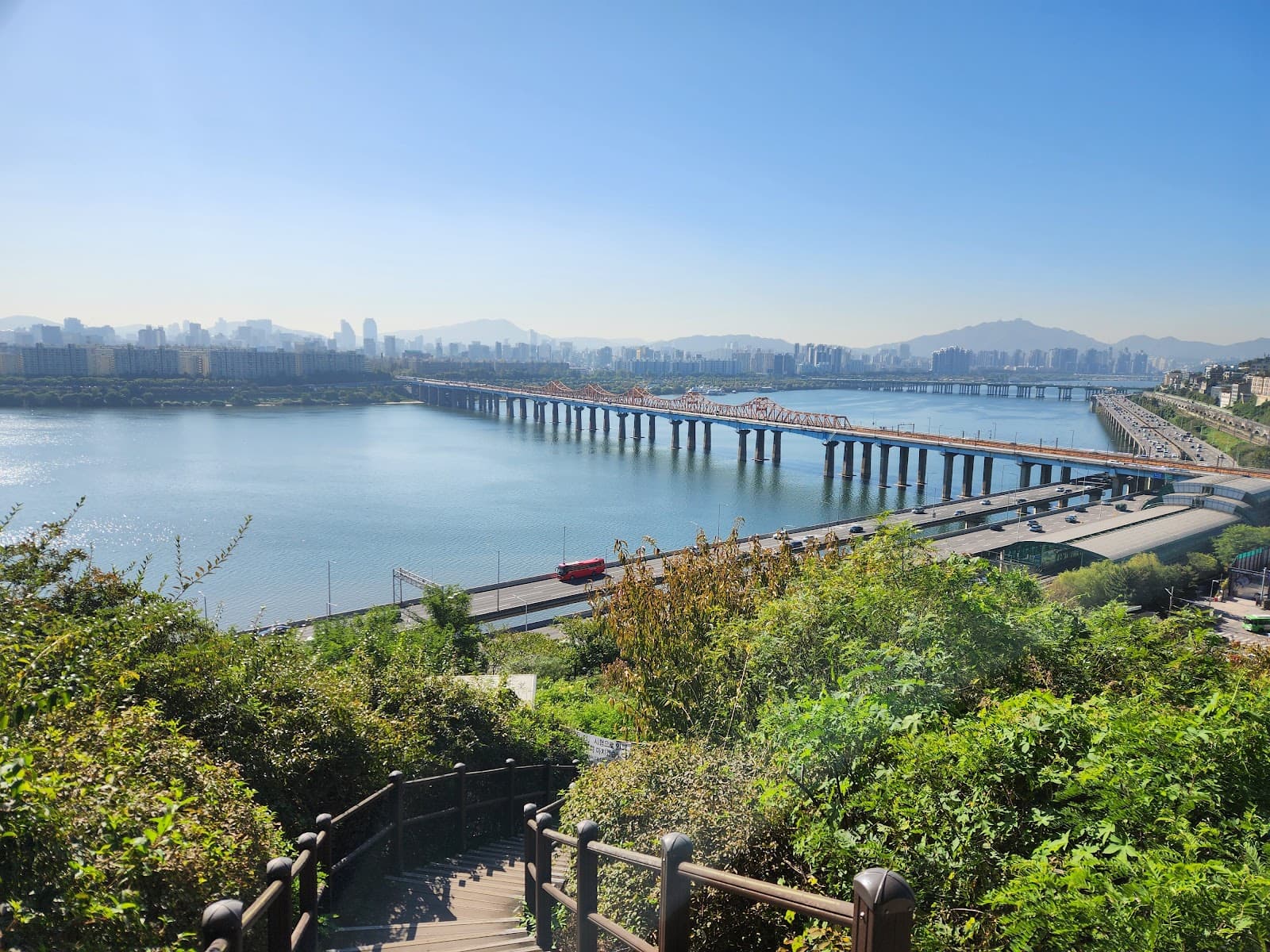
The first thing you notice is the gradient. Changsin-dong climbs steeply — these are proper hills, not Seoul's usual gentle inclines. The streets narrow as you go higher. Between buildings you catch glimpses of the city spreading south and west: the curve of the Han River on clear days, DDP's aluminum mass visible below you like a large landed spacecraft.
At the top of the hill sits Naksan Park (낙산공원). It's one of the four mountains that originally defined Hanyang's inner city, and Seoul's ancient city wall — the Hanyangdoseong — runs directly through it, following the ridge in a long stone line that connects toward Changdeokgung Palace to the west and Hyehwa neighborhood to the east.
In early spring, late March through mid-April, the slopes around Naksan Park are covered in forsythia and cherry trees. The forsythia arrives first, turning the hillside a vivid yellow before the cherry trees open. Families from the surrounding neighborhoods come up in the evenings. University students from Seonggyungwan University and nearby campuses walk here on weekends.
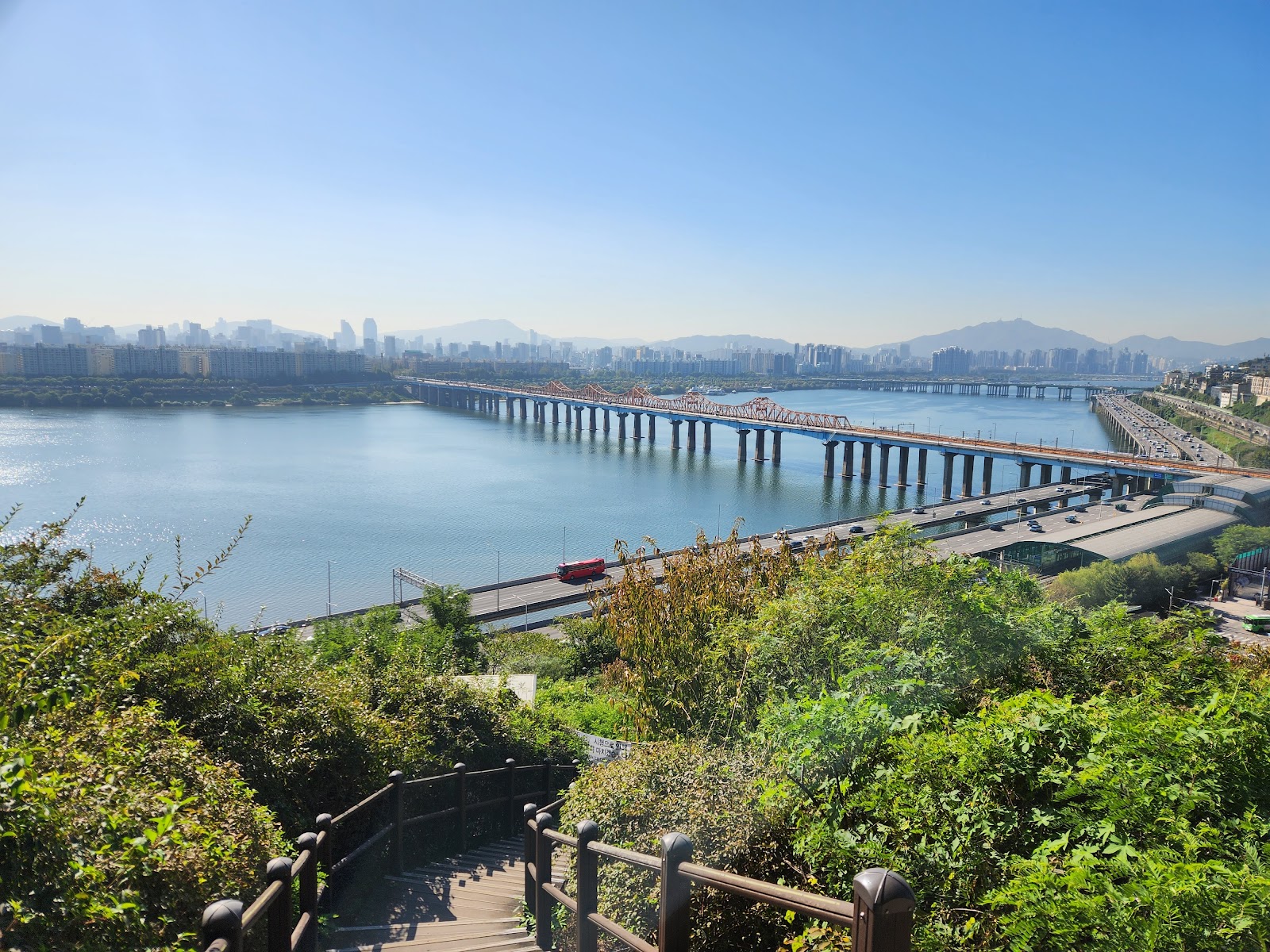
The walk along the city wall through Naksan takes about 30–40 minutes end to end. It's free, well-maintained, and one of the genuinely underrated walks in central Seoul. Go early on weekdays and you'll have the stone path mostly to yourself — maybe sharing it with older residents doing their morning exercise, photographers catching light through the cherry branches, or a mother pushing a stroller along the flat-paved upper stretch.
The Hanyangdoseong walking guide covers all six wall sections in detail, but if you have time for only one, the Naksan section — with its urban backdrop, spring blossoms, and direct connection into a living working-class neighborhood — is worth choosing.
Down Into the Sewing Village
From Naksan Park, descend back into Changsin-dong itself. The neighborhood reveals itself differently on foot than from above.
The sewing workshops are visible if you know what to look for: a building with industrial-grade electrical connections where residential buildings usually have lighter wiring. Windows where fabric bolts lean against the glass. A heavy metal door with Chinese paper numbers posted outside — order quantities for the season. Carts loaded with finished garments being wheeled down the hill, covered in plastic sheeting against the weather.
Most workshops are family operations: a husband-and-wife team taking in finishing work, a small three-person co-op specializing in one type of garment. The machinery is industrial but the scale is intimate — this isn't a factory, it's someone's living space that also happens to be their workplace.
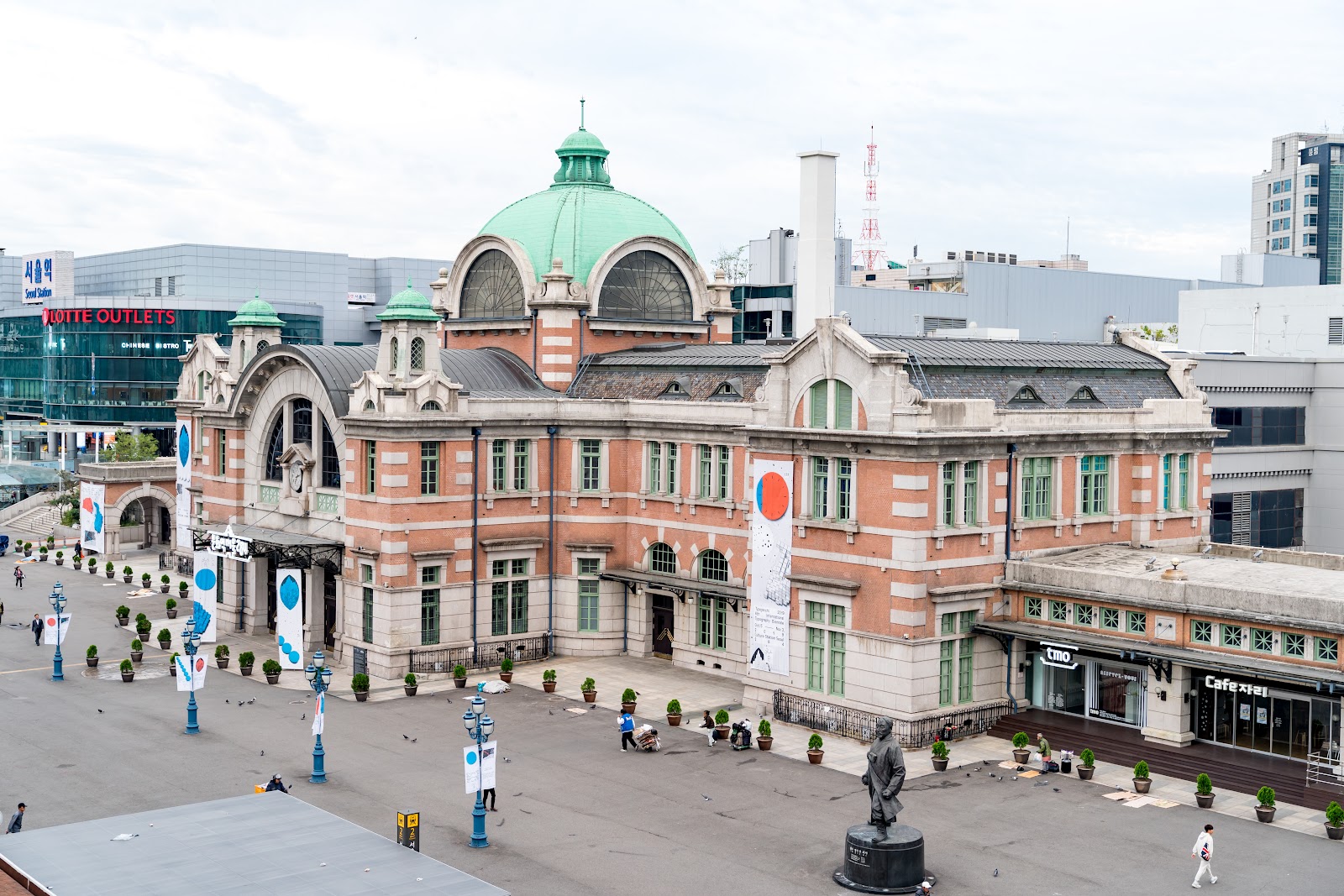
The Changsin-dong Sewing History Hall (창신동 봉제역사관) is a small museum that tells this story directly. It's tucked into an alley near the heart of the sewing district — easy to miss if you don't know it's there. The exhibit documents the neighborhood's transformation from 1960s residential area to garment production hub, with photographs, sample patterns, and working machinery from the era. Entry is free. Staff members — many of them longtime neighborhood residents — are happy to explain the displays, though English support can be limited.
The kind of knowledge you only get here: each specialty in Changsin-dong occupies its own block. Sections that do finishing work. Others that specialize in stitching buttonholes. The internal delivery network that links them all into an invisible assembly line running up and down the hillside.
The New Arrivals
In the last three or four years, something began shifting.
It's happened in every former-industrial neighborhood in Seoul: Mullae, Euljiro, Sindang. A few cafes appeared in spaces that used to be workshops. Not replacing them — the garment workers are still there — but opening in ground-floor units that had been sitting empty, or in spaces where an older generation of workers had retired.
In Changsin-dong, the new arrivals are quiet about it. There's no neighborhood-wide brand, no Instagram guide with seventeen coffee shops to visit. But if you walk the lower slopes below the city wall, you'll find a handful of specialty coffee spots that have made a deliberate choice to open here, among the sewing machines.
These cafes tend to share a particular aesthetic: deliberate about not performing nostalgia. They work with the existing industrial infrastructure — high ceilings, concrete floors, the existing ventilation — rather than decorating around it. The clientele is genuinely mixed: young designers who work with Dongdaemun's wholesale markets come up for coffee, garment workers stop in after a shift, photography students from nearby universities come with cameras.
This coexistence — old industry and new culture in the same block — is the specific thing you don't get in Seongsu-dong or Euljiro anymore. Those neighborhoods completed their transformation. Changsin-dong is still mid-sentence.
Walking Into Ihwa
From Changsin-dong's northern edges, a fifteen-minute walk east along the wall path brings you to Ihwa-dong (이화동), the neighborhood known for its mural walls. The murals aren't as frequently updated as they once were, but the alleys themselves remain interesting to walk — steep, narrow, and with that particular quality of old Seoul hillside neighborhoods where the topography shapes everything.
What connects Ihwa and Changsin-dong isn't just geography. Both occupy the slopes of Naksan, both have the same late-afternoon light falling through their narrow stepped alleys, and both are in that Seoul liminal state where they're known but not overrun.
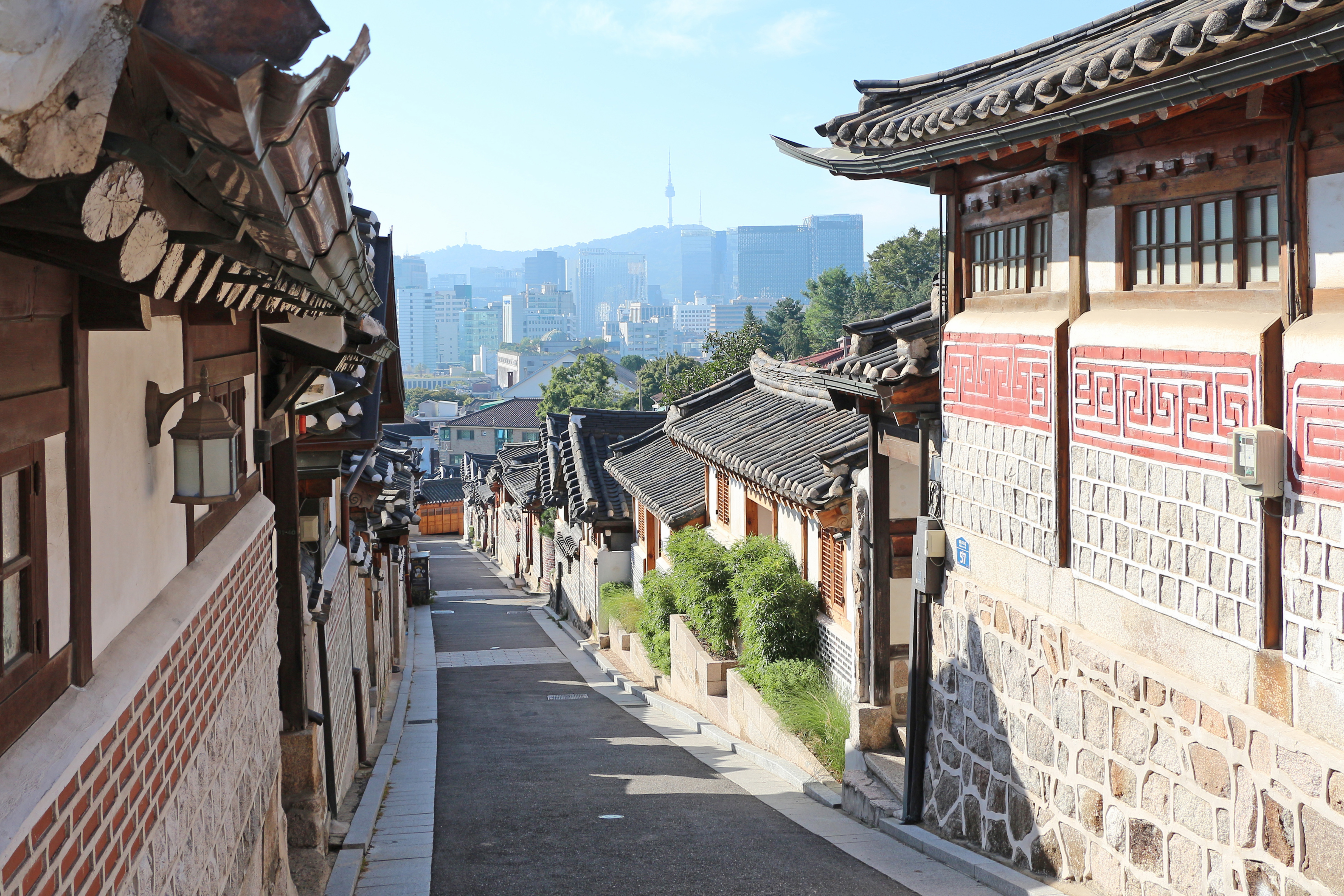
Continue east from Ihwa and you'll eventually reach the Hyehwa neighborhood — small theaters, university streets, and the eastern trailhead for the Naksan wall walk. It makes for a natural circular route: up from Dongdaemun through Changsin-dong, along the wall through Naksan, east through Ihwa, down into Hyehwa.
What the Neighborhood Teaches
Changsin-dong isn't a neighborhood you visit for a single destination. There's no famous building, no food pilgrimage, no single Instagram corner that tells the whole story.
What it offers is rarer in Seoul: the experience of a neighborhood that hasn't fully decided what it's becoming. The garment workers have been here for fifty years. The specialty cafes have been here for three. The city wall has been here for six hundred. All of them are on the same slope, somehow coexisting without the earlier layers needing to disappear for the newer ones to exist.
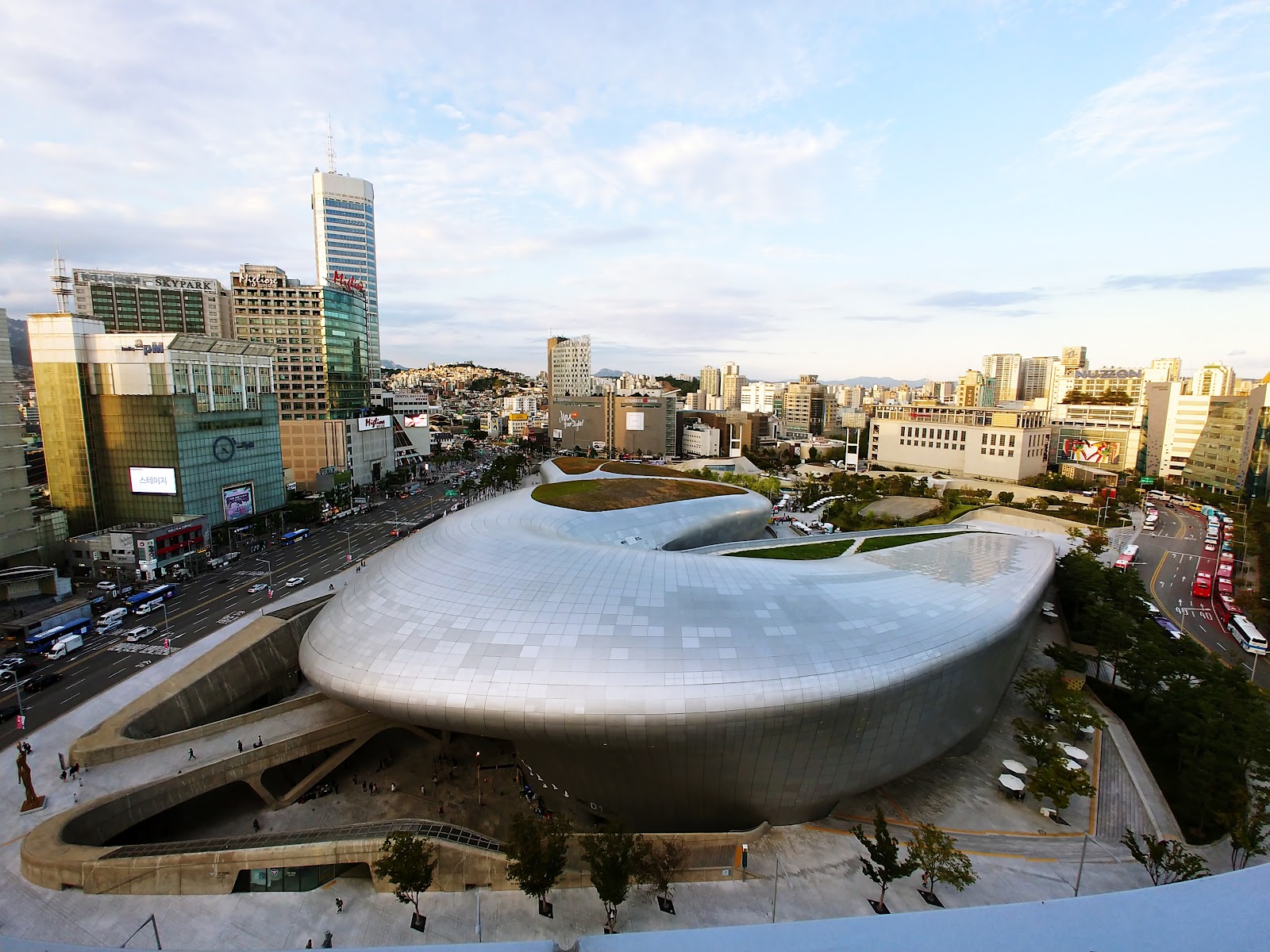
Walking back down from Naksan to DDP, the transition is jarring in a useful way. The aluminum surfaces of Hadid's building catch the evening light differently once you've spent a few hours in a neighborhood where the main sound is sewing machines and the main landmark is a 600-year-old stone wall.
Found during my morning walk through Changsin-dong: A paper note tacked to a utility pole near one of the workshops — a hand-lettered announcement for a group buyout of a fabric lot, the old-fashioned way orders circulate in the neighborhood. The contact at the bottom was a KakaoTalk QR code. Old and new at exactly the same time.
Planning Your Visit
Getting there
- From Dongdaemun Station (Lines 1 & 4, Exit 3): Walk north — the street starts climbing within 10 minutes. Follow the slope and you're in Changsin-dong.
- From Hyehwa Station (Line 4, Exit 2): 5-min walk to Naksan Park's eastern entrance. Walk west along the wall path and descend into Changsin-dong.
Best timing
- Spring (late March–April): Best for the Naksan Park cherry blossom and forsythia trail. Come weekday mornings for a quiet wall walk.
- Weekday afternoons: Sewing workshops are most active Monday–Friday between 10am–4pm. The neighborhood sounds and rhythms are most distinct then.
How long to spend Allow 3–4 hours for Naksan Park + the sewing village walk + one cafe stop. Add another hour if you continue to Ihwa-dong and Hyehwa.
Budget Naksan walk and Sewing History Hall are free. A coffee runs ₩5,000–7,000 at the specialty cafes on the lower slopes. The whole visit fits comfortably under ₩15,000.
Combine with
- Euljiro (20-min walk south through Jongno-gu) for a full day of industrial Seoul exploration
- Sindang-dong (20-min walk southeast) for more quiet neighborhood discovery
- Insadong (15-min walk west) for a cultural contrast on the same day
What Visitors Ask
Is Changsin-dong safe to explore alone? Completely. It's an active residential and commercial neighborhood. Daytime is the most interesting time to visit — you'll have company from residents and workers going about their day. The city wall walk is well-maintained and lit.
Can I go inside the sewing workshops? The workshops are private workplaces, not visitor spaces. Walking the alleys and observing the activity from the street is appropriate. The Sewing History Hall is designed for visitors and is the right place for a deeper look at the industry and its people.
Do I need Korean to navigate? Not to walk the neighborhood. The Sewing History Hall staff may have limited English, but the exhibits include enough visual content to follow without language. The cafes are used to international visitors — pointing at the menu works fine.
Is there food in Changsin-dong? The neighborhood has local Korean restaurants serving lunch for workers — simple, inexpensive, and genuinely local. Nothing is set up specifically for tourists, which is part of the appeal. Ask at one of the cafes if you want a recommendation; they'll know what's nearby.
What's the best season? Spring (March–April) for the Naksan blossoms and forsythia. Autumn (October–November) for foliage along the city wall path. Winter is quiet with fewer people on the trail and the workshops running at full tilt for end-of-year orders. Each season offers a different reading of the same place.