Insadong: Walking Through Seoul's Living Cultural Heart
In 1910, when Japanese colonial administrators began reshaping Seoul in their own image — relocating palace gates, demolishing hanok neighborhoods, replacing traditional commercial streets with grid-plan districts — one alley refused to disappear. The antique dealers, calligraphers, ink-stone merchants, and traditional craft sellers of Insadong-gil simply stayed where they had always been.
This was not accidental. Through the colonial period, Insadong became a quiet act of cultural resistance. Korean collectors and scholars gathered here to buy and preserve objects that mattered — celadon bowls, calligraphy scrolls, folk paintings, Buddhist ritual implements — artifacts that colonial rule was systematically erasing from public life. The alley that housed these transactions became, almost by default, one of the few places in Seoul where Korean material culture could be openly seen, sold, and valued.
More than a century later, Insadong remains Seoul's most important traditional culture district. It is not a museum or a theme park. It is a living street, still functioning much as it has for generations, with all the complexity and contradiction that implies. International tourists and Korean visitors walk the same 700-meter main alley, browse the same mix of authentic antiques and tourist-oriented crafts, and drink tea in the same traditional courtyards where poets once debated the fate of their country.
Understanding what Insadong is — and what it isn't — makes the difference between a frustrating tourist trap experience and one of the most culturally rewarding afternoons in Seoul.
The Geography of Tradition
Insadong occupies a roughly 700-meter stretch of Insadong-gil between Anguk Station to the north and Tapgol Park to the south. The main street, wide enough for two lanes of slow traffic and crowded sidewalks, is supplemented by a network of narrower alleys branching east and west, each with its own character.
The district sits within Jongno-gu, Seoul's most historically significant borough. Gyeongbokgung Palace is a 10-minute walk to the northwest. Gyeonghuigung is 20 minutes west. Changdeokgung is 15 minutes northeast. Insadong is not peripheral to Seoul's heritage district — it is embedded within it, a civilian counterpart to the royal architecture that surrounds it.
This geography matters. The Joseon Dynasty maintained a strict hierarchy between the royal palaces, the government districts, and the commercial areas. Insadong's position near the government district meant that educated officials, scholars, and artists circulated through it. The antique trade that developed here was not a low-status market business but a sophisticated cultural economy connected to the educated class.
How a Street Survived
To understand why Insadong looks the way it does, it helps to understand what was lost elsewhere.
Most of Seoul's traditional commercial districts were destroyed during the rapid industrialization of the 1960s and 1970s. Narrow alley markets were widened into roads. Hanok courtyard houses were replaced by concrete apartment blocks. The small-scale, pedestrian-oriented urbanism of the Joseon and early modern period largely vanished.
Insadong's survival involved several factors. The antique trade created an economic incentive to preserve the physical environment: galleries, tea houses, and specialty shops require intimate, small-scale spaces. A concrete shopping mall would have killed the district's character — and the business model that sustained it.
Korean cultural preservation activists also recognized the district's importance. In 1988, Insadong-gil was designated as a "Cultural Tourism Zone." This protected it from the kind of development that had destroyed comparable districts elsewhere. Restrictions on chain stores and standardized commercial signage helped preserve the street's character into the 21st century.
The protections are not absolute. Starbucks operates in Insadong — though in a building that maintains the neighborhood's aesthetic, its signage in traditional Korean script rather than the usual Roman letters. The tension between commercial pressure and cultural preservation continues. But the core character of the street has survived in a way that comparable districts in other Asian cities rarely have.
The Main Street: What to Look For
Walking north from Tapgol Park toward Anguk Station, you pass through the main commercial artery of Insadong. The street is closed to private vehicles on weekends, becoming a pedestrian zone that fills with visitors, street performers, and vendors selling traditional street foods.
The gallery-to-souvenir ratio on the main street has shifted toward the commercial end over recent decades. Many of what appear to be traditional craft shops sell mass-produced items dressed in traditional aesthetics. This doesn't mean the main street has nothing to offer — but it does mean you need to know what to look for.
Genuine antique shops are concentrated toward the northern end of the street, near Anguk, and in the side alleys. These are typically smaller, with less visual excitement and lower lighting — the contents are old and require close attention. Look for shops with celadon (청자), white porcelain (백자), old wooden furniture, traditional paintings, and bronzeware. Prices are real and negotiable; the presence of older Korean clientele is usually a good sign.
Hanji (한지) specialty shops sell traditional Korean paper, handmade from mulberry bark. The quality ranges from machine-made tourist items to genuinely hand-crafted paper that costs more but is a remarkable material — strong, translucent, and capable of lasting centuries. High-quality hanji makes an exceptional gift that most visitors have never encountered.
Ink and calligraphy shops still operate in the area, serving both the small community of traditional calligraphers who work in this style and collectors seeking traditional writing implements. The brushes, ink stones, and paper sold here are functional tools, not purely decorative.
Folk paintings (민화 minhwa) — the bright, symbolically loaded paintings of tigers, magpies, peonies, and fish associated with Korean folk tradition — can be found throughout Insadong, though quality varies enormously. Original antique minhwa and high-quality reproductions coexist with tourist-grade prints. The difference is visible in the materials and the detail of the brushwork.
Ssamziegil: The Market That Captures a Spirit
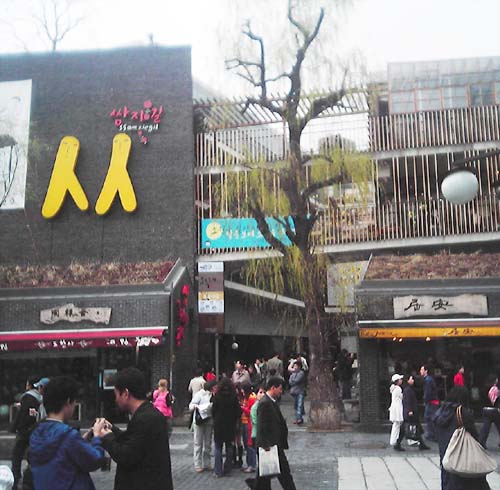
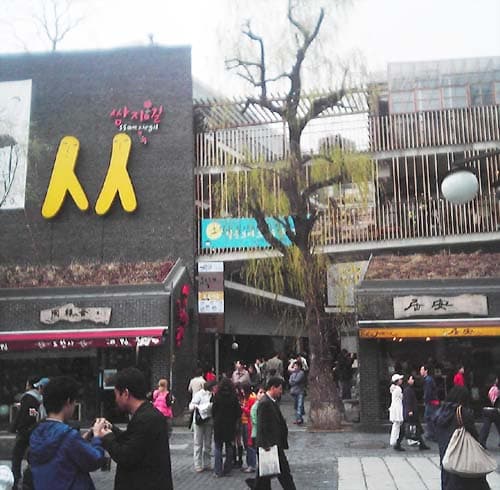
About halfway up Insadong-gil, a passageway on the left leads into Ssamziegil (쌈지길), one of the most interesting small commercial buildings in Seoul. Designed by architect Roh Eun-ju and completed in 2004, it occupies the site of a traditional Korean courtyard (마당), which it honors by centering the entire building on an open open courtyard rather than filling it with retail space.
The building spirals upward over four floors, with galleries, craft studios, and specialty shops arranged along the ascending walkway. The tenants are genuinely curated — this is not a standard mall. You'll find independent jewelry designers working with traditional Korean aesthetics, fabric artists using pojagi (Korean wrapping cloth) techniques, ceramic studios where pieces are made on-site, and print workshops doing traditional block printing.
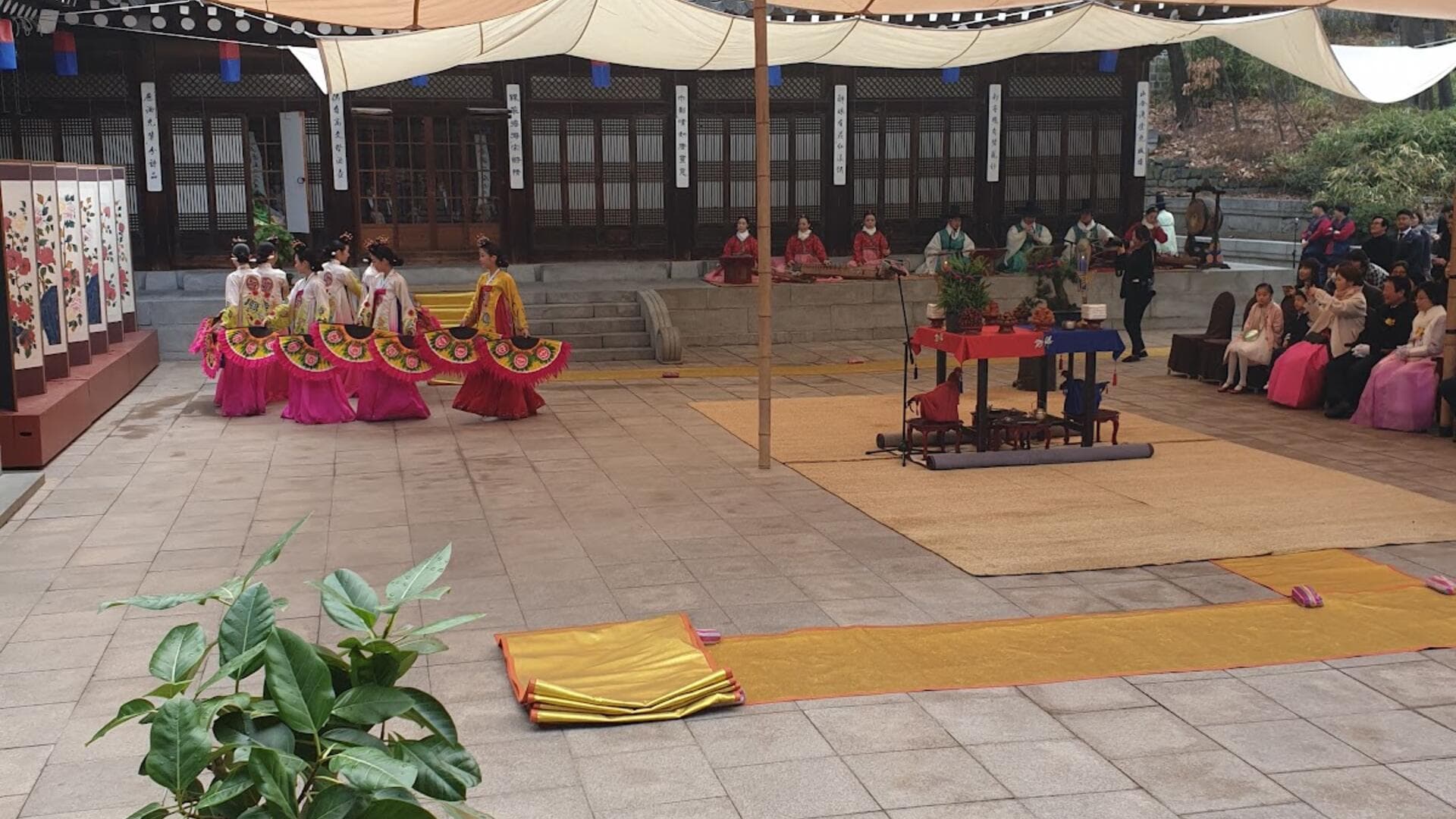
The outdoor performance area in the courtyard hosts regular events: folk music performances, traditional craft demonstrations, markets featuring independent Korean designers. On weekend afternoons, this often becomes the most culturally alive space in Insadong.
For visitors who want to buy something genuinely made in Korea — not just assembled from imported materials — Ssamziegil's curated tenants offer better options than the main street. Prices are higher than tourist shops; the quality gap justifies this.
Ssamziegil is open daily from 10:00 to 22:00. Entry is free.
The Tea Houses: Insadong's Inner Life
Behind the commercial surface of Insadong lies a quieter world. Several traditional tea houses (전통찻집) operate in the district, serving Korean teas in environments that have changed very little in decades. These are not Instagram-optimized spaces designed for tourist photography. They are genuine working teahouses where you might find yourself sharing a table with an elderly Korean gentleman who has been coming here every week for thirty years.
Dawon (다원), located in the courtyard behind the Kyungin Museum, is perhaps Insadong's most authentic remaining tea culture experience. The stone-paved courtyard, surrounded by old trees and traditional architecture, feels almost improbably quiet given that you are in the center of a busy tourist district. The tea menu runs to dozens of varieties: traditional Korean teas made from barley, persimmon leaf, ginger, jujube, and dried flowers, alongside Chinese-style teas. The service is unhurried. Plan for at least an hour.
Suyeon Sanbang (수연산방), a short walk from the main street, occupies a traditional hanok house that was once the home of Korean novelist Yi Tae-jun (1904-?), who wrote there during the 1930s and 1940s before the division of Korea disrupted his life. The house has been converted into a teahouse but retains the spatial character of a private scholarly residence. The literary history adds a layer of meaning to sitting in the front courtyard with a bowl of tea.
For a deeper understanding of Korean tea culture, our guide to traditional tea ceremonies provides full context on the aesthetics and practice behind what you experience in these spaces.
Jogyesa Temple: The Buddhist Heart of Seoul
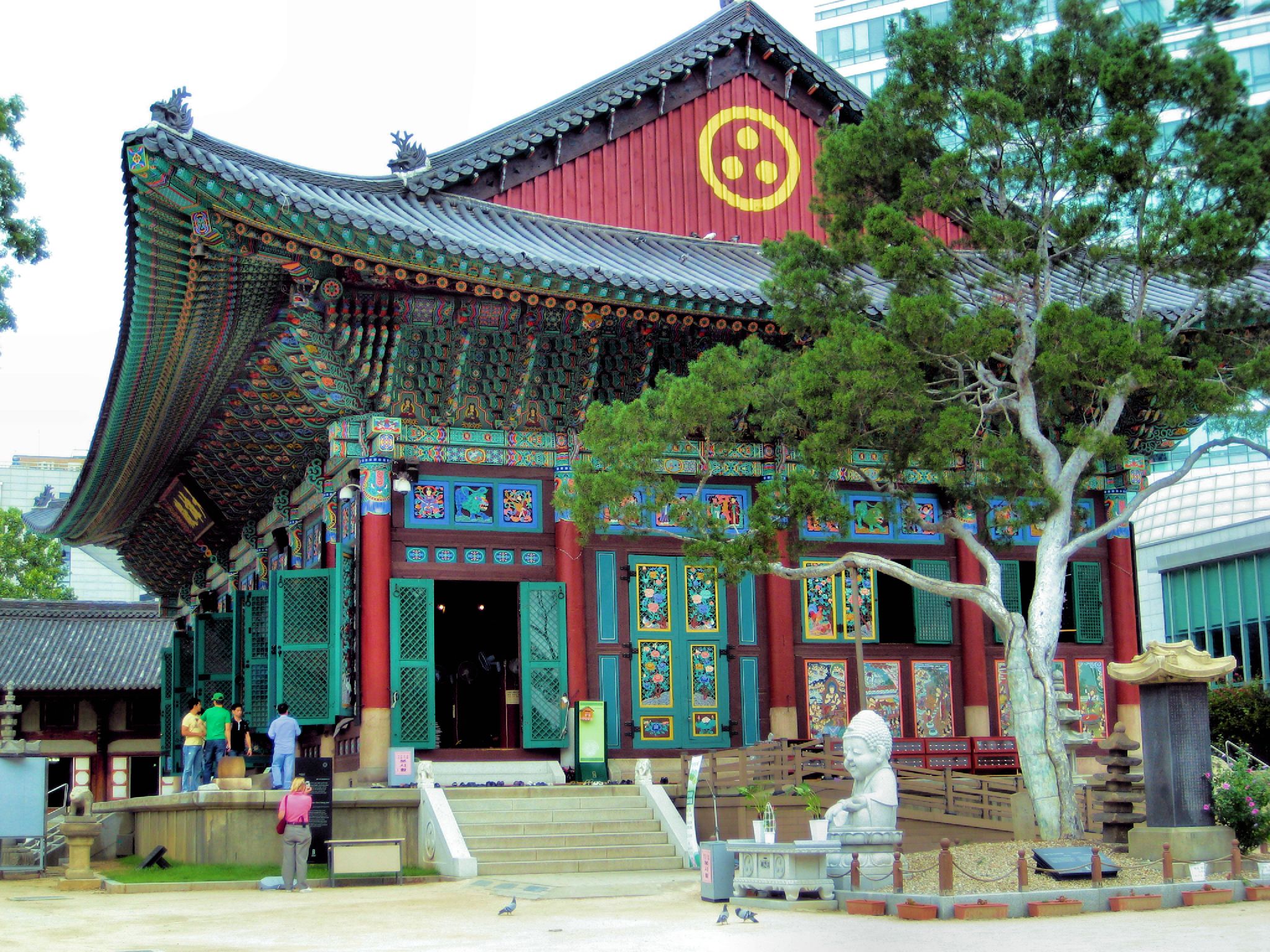
Five minutes' walk east of Insadong-gil brings you to Jogyesa Temple (조계사), the head temple of the Jogye Order — which means it is effectively the headquarters of Korean Buddhism. This is a functioning religious center, not a heritage site in the sense of a museum. Monks live and practice here. Ceremonies take place daily. The resident community maintains an active presence.
Jogyesa's location — in the center of a major city, surrounded by government offices and commercial buildings — reflects a historical resilience that parallels Insadong's own story. The temple grounds were established in 1910, the year of Japanese annexation, in a conscious act of Korean Buddhist assertion against a colonial order that preferred Shinto. The main hall, Daeungjeon, is classified as National Treasure No. 162.
Entering the temple grounds, visitors move from Seoul's urban noise into a compound of surprising calm. The old zelkova tree at the main entrance is over 500 years old — it was growing here before the temple itself was established. The courtyard in front of Daeungjeon often has colored lanterns hanging in preparation for upcoming Buddhist festivals, the most spectacular of which is the Lotus Lantern Festival in May, when the area transforms completely.
What to understand when visiting: Jogyesa is a working temple. Photographs are generally acceptable in the courtyard and exterior areas; be more cautious when monks are actively conducting ceremonies or when entering the main hall. Remove shoes before entering any interior religious space. Quiet, respectful behavior matters here in a way that is sometimes lost in busier heritage sites.
Jogyesa is open to the public daily from 4:00 AM to 9:00 PM. Entry is free.
Tapgol Park: Where Korean Independence Began
At the southern end of Insadong-gil stands Tapgol Park (탑골공원), a modest park that carries extraordinary historical weight.
On March 1, 1919, students, religious leaders, and ordinary citizens gathered at Tapgol Park to read aloud the Korean Declaration of Independence — a document signed by 33 national representatives defying Japanese colonial rule. This was the beginning of the March 1st Movement (삼일운동), the largest and most significant act of organized Korean resistance during the colonial period. Demonstrations spread from this spot across the entire peninsula. The Japanese response was violent: historians estimate that several thousand Koreans were killed in the suppression.
The park contains the original Wongaksa Temple pagoda (원각사지 십층석탑), a marble structure built in 1467 during the reign of King Sejo, making it one of the oldest stone structures in central Seoul. The pagoda is now protected behind glass, but its presence gives the park a depth that predates both the Independence Movement and the colonial period by four centuries.
Relief sculptures along the park's outer wall depict scenes from the March 1st Movement with a directness that is unusual in Korean public art. These were added in 1979 during a period of renewed attention to colonial history.
Tapgol Park today is often occupied by elderly men who gather to play chess and socialize — a very different scene from the revolutionary moment of 1919. But the combination of the medieval pagoda, the independence history, and the present-day life of the park makes it one of the most layered public spaces in Seoul.
The park is free to enter and open daily from 6:00 AM to 9:00 PM.
Street Food: Seasonal and Traditional
Insadong has its own food culture, distinct from the modern Korean street food scenes in Hongdae or Myeongdong.
Honeycomb candy (달고나) has been made and sold by street vendors in Insadong for generations. A copper ladle, a gas flame, sugar, and baking soda: the vendor heats and stirs the mixture until it becomes caramel-colored and foamy, pours it flat, and stamps it with a shape. The challenge is to extract the stamped shape without breaking it. This predates the dramatized version in the television series that made it internationally famous — here it is simply what it has always been, a cheap street sweet.
Traditional Korean rice cakes (떡) are sold from shops and stalls throughout the district. The varieties are seasonal: spring brings rice cakes made with mugwort (쑥떡) and other foraged greens; summer brings cooling grain drinks; autumn brings chestnuts and red beans in various preparations. In March, look for 쑥떡 if available — the mugwort gives the rice cake an earthy, slightly bitter character that cuts through sweetness in a way that is distinctly Korean.
Bindaetteok (빈대떡) — mung bean pancakes — are sold hot at several spots in the area. These dense, crispy pancakes were historically considered peasant food; today they are one of the authentic traditional street foods that Insadong does particularly well.
The Gallery District
Beyond the antique shops, Insadong and the surrounding streets contain one of Seoul's denser concentrations of commercial art galleries. Most of these focus on Korean contemporary art, but with a visible dialogue between traditional and modern aesthetics.
Kyungin Museum of Fine Arts (경인미술관) is one of the older gallery complexes in the area, with multiple exhibition spaces arranged around a traditional garden. The courtyard contains Dawon tea house (mentioned above). The gallery's exhibitions tend toward established contemporary Korean artists; the permanent collection includes traditional crafts.
Gallery Hyundai, slightly east of the main Insadong street, is one of Seoul's most significant contemporary art galleries, with a history stretching back to 1970. Its programming reflects the full range of Korean contemporary art.
For those interested in acquiring Korean art, the galleries in Insadong and the surrounding Samcheong-dong area — a short walk north — provide more context and quality assurance than the antique market on the street level.
Visitor Information 2026
Getting There
The most direct subway access is via Line 3, Anguk Station (Exit 6): a 3-minute walk south puts you at the northern end of Insadong-gil. This approach is recommended because it allows you to walk downhill through the district toward Tapgol Park, which is the most natural direction.
Alternatively, Line 1 or 3, Jongno 3-ga Station (Exit 3): 5-minute walk north to Tapgol Park and the southern entrance.
Hours and Days
Insadong-gil is pedestrianized on Saturdays, Sundays, and national holidays from 10:00 AM to 10:00 PM. On these days the street becomes significantly more lively and atmospheric, with street performers and additional vendors. Weekday visits are quieter and better for those who prefer a calmer environment for exploring galleries and antique shops.
Individual shops typically open between 10:00 and 11:00 AM and close between 7:00 and 9:00 PM. Most are closed on Mondays.
Time Required
- Main street walk only: 1 hour
- Including Ssamziegil and a tea house: 2-3 hours
- Including Jogyesa Temple and Tapgol Park: 3-4 hours
- Including gallery visits: add 1-2 hours
Language
English signage is more common in Insadong than in most traditional Seoul districts, reflecting decades of international visitor traffic. Gallery staff often speak some English. Antique dealers vary — some have considerable English; others communicate through gesture and price negotiation. Basic Korean phrases (얼마예요? — "How much?") are helpful.
A Note on Prices
Legitimate antiques in Insadong are priced as genuine antiques. A quality piece of antique celadon will cost hundreds of thousands of won; museum-quality pieces far more. Do not expect to find a treasure at a market stall price — the antique dealers here are professionals with decades of experience. For tourist-oriented crafts, negotiation is expected and accepted. For galleries and established antique shops, prices are typically fixed.
Combining With Nearby Sites
Bukchon Hanok Village is accessible from Anguk Station: instead of turning south toward Insadong, turn north for Bukchon's traditional residential streets. The two areas offer complementary perspectives — Insadong shows traditional commercial culture; Bukchon shows traditional residential architecture. Allow half a day for each.
Gyeongbokgung Palace is 15 minutes' walk west from Anguk Station. A natural pairing: visiting Korea's most important palace in the morning and spending the afternoon in its cultural complement district.
Samcheong-dong, immediately north of Anguk Station, has a higher concentration of contemporary art galleries and cafes. The transition from Insadong to Samcheong-dong is one of Seoul's most interesting cultural gradients: from traditional to contemporary, from antiques to new work.
For those interested in exploring Seoul's traditional craft heritage further, our guide to traditional craft workshops covers hands-on experiences in pottery, hanji-making, and other Korean artisan traditions.
What Insadong Is For
Insadong requires a particular kind of attention. It will not overwhelm you with spectacle. It will not present itself as a theme park version of Korean tradition. What it offers is something rarer: a continuous thread from the Joseon era's scholarly culture through the resistance of the colonial period to the present, visible in the streets, the objects, and the people who continue to gather here.
It is important to understand that this is not a sealed historic district — it is a living commercial area with all the tensions that implies. The shops selling mass-produced "traditional" crafts exist alongside genuine master craftspeople. The tourist restaurants coexist with Korean grandmothers who have eaten here for fifty years. This combination is not a failure of preservation; it is what preservation actually looks like when a neighborhood continues to function rather than becoming a museum exhibit.
The most valuable thing to bring to Insadong is time — enough to stop, to look closely at things, to sit in a tea house without hurrying. The district rewards attention. The 1919 march began here. The classical scholars browsed these same lanes. The objects in the antique shops passed through hands across centuries before arriving at this street.
That continuity is Insadong's gift to the visitor willing to receive it.
Frequently Asked Questions
When is the best time to visit Insadong? Weekends are more atmospheric, as the main street is pedestrianized and more active with performers and vendors. Weekdays are better for gallery and antique shopping, with fewer crowds and more opportunity to speak with shopkeepers. Spring (March-May) is particularly beautiful, with the Lotus Lantern Festival at Jogyesa Temple in May being a highlight.
Is Insadong worth visiting in 2026? Yes, though with realistic expectations. The district has become more commercial over the decades. The key is knowing where to spend time: Ssamziegil's curated shops, the traditional tea houses, Jogyesa Temple, and the genuine antique dealers in the side alleys offer authentic experiences. The main street's souvenir shops are largely interchangeable with any tourist district.
How do I tell genuine antiques from reproductions? This is the fundamental skill of the antique market, and it takes experience to develop fully. General indicators: genuine old ceramics show uneven glazing, natural crazing, and subtle variations in color. Mass-produced reproductions are too even, too bright, too perfect. For significant purchases, reputable dealers will discuss provenance. If you're serious about buying antiques, coming with a knowledgeable Korean friend is invaluable.
What is the relationship between Insadong and Bukchon? They are complementary areas sharing the Anguk Station access point. Bukchon is primarily residential traditional architecture (hanok houses, narrow lanes); Insadong is commercial and cultural (galleries, shops, tea houses). Together they represent the civilian side of traditional Seoul's cultural geography.
Is Jogyesa Temple appropriate for non-Buddhist visitors? Yes. Jogyesa actively welcomes visitors of all backgrounds. Respectful behavior — quiet movement, removing shoes in interior spaces, avoiding photographing worshippers at close range during ceremonies — is what is asked. The temple has bilingual information available for international visitors.
What happened at Tapgol Park in 1919? On March 1, 1919, the Korean Declaration of Independence was read aloud here before a large crowd. This was the catalyst for the March 1st Independence Movement, which spread across Korea over the following weeks. The Japanese colonial response was violent; thousands of Koreans were killed or arrested. The March 1st Movement is commemorated annually as a national holiday (삼일절) on March 1st.
Are there English menus in the tea houses? Most of Insadong's traditional tea houses have menus in Korean and English. The teas themselves are often unfamiliar to international visitors; asking for recommendations based on taste preferences (sweet/mild vs. strong/bitter) works well. Staff at major tea houses generally speak enough English for this.
Can I use a credit card in Insadong shops? Major galleries and established shops accept cards. Small street vendors, traditional food sellers, and some antique dealers prefer cash. Bringing Korean won is recommended, particularly for purchases under ₩30,000.